
Tenant electric billing
Submeter billing software that creates your tenant invoices
MeterSight reads each tenant's submeter, applies your blended rate and creates an electric invoice for every tenant, every billing cycle. You stop paying for power you don't use.
- Industrial parks and multi-tenant buildings
- Any Modbus submeter
- Sites anywhere in the US
You're paying for your tenants' electricity
On a master-metered property, the utility sends one bill and you pay all of it. If your tenants aren't billed for what they use, that cost comes straight out of your operating income, and tenants have no reason to turn anything off.
Submeters measure each tenant's share. MeterSight turns those readings into invoices, so each tenant pays for their own power and you pay only for the common areas.
Submetering versus splitting the bill
| Submeter billing | RUBS or square footage | |
|---|---|---|
| Tenants pay for | What their meter measured | A formula |
| Saving energy | Lowers their bill | Barely matters |
| Disputes | Two readings and one rate | Hard to defend |
How MeterSight bills your tenants
Set up your meters, tenants, cycle day and rate once. After that, every cycle closes into invoices.
22,384.6kWh
Read the tenant's meter
Bronze reads cumulative kWh from your Modbus meters and closes each billing period on the day you choose.
$0.08per kWh
Apply your blended rate
Divide the utility bill by the kWh on it. That one rate already carries the demand charges, fees and taxes.
$1,790.77
Send the energy invoice
Bronze creates an invoice for each tenant with bill-to, account, meter, dates and a line for adjustments or fees.
Worked example: one bill, four invoices
An industrial park's utility bill is $4,312.80 for 34,696 kWh. That's a blended rate of $0.1243/kWh.
Three tenant meters and the common-area meter record the cycle's usage. MeterSight multiplies each tenant's kWh by the blended rate and creates their invoice. Shared yard lighting and the common area stay with the owner.
The invoices add up to the tenants' share of the bill, because the rate came from the bill.
| Metered space | kWh | Invoice |
|---|---|---|
| Unit A, machine shop | 11,240 | $1,397.13 |
| Unit B, cabinet shop | 8,420 | $1,046.61 |
| Unit C, warehouse | 6,815 | $847.10 |
| Common areas | 8,221 | Owner |
| Utility bill | 34,696 | $4,312.80 |
What you need to start
- A meter for each tenant's load. One meter per tenant, or a multi-circuit meter covering several tenants' breakers.
- Meters that talk Modbus. Most commercial power meters and many submeters already do. Check supported meters.
- A network path to the meters. Ethernet meters connect directly. RS-485 meters connect through a Modbus gateway.
- Your last utility bill. Its total cost and total kWh give you the blended rate.
- MeterSight Bronze, in our cloud or on a Windows computer at the property.
Not sure your meters will work? Send us the make and model and we'll tell you.
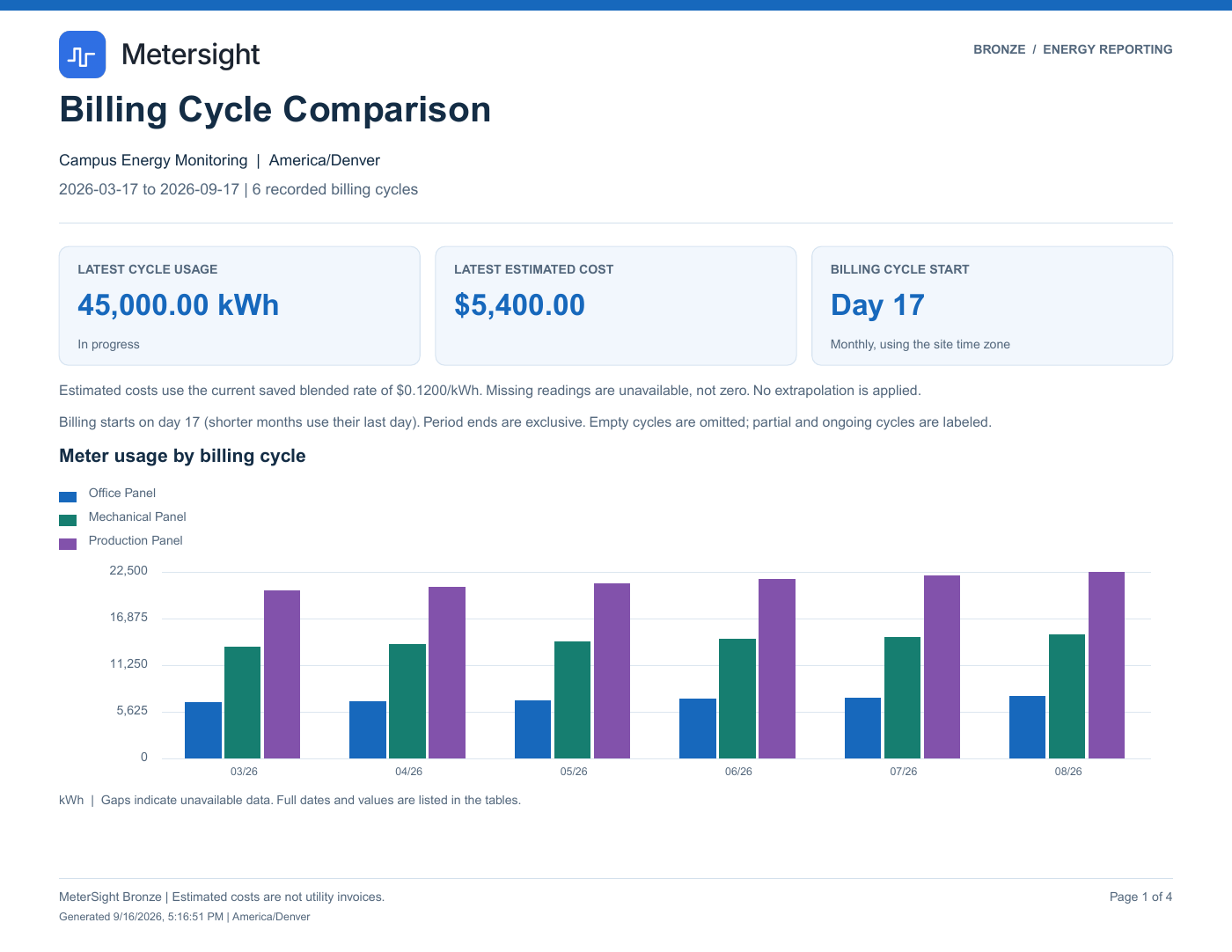
Who bills with MeterSight
Industrial and flex parks
Fair bills for heavy, uneven loads, demand included.
Manufacturing plants
Charge energy back to lines, departments and on-site tenants.
Cities and municipalities
Invoice departments and lessees in city-owned buildings.
Tenant submeter billing questions
Does MeterSight create tenant invoices?
What's the difference between submetering and RUBS?
Do I need a meter for every tenant?
What does a blended rate include?
Is submeter billing allowed in my state?
Can my billing cycle match the utility's?
Can we use the cloud version?
Bill your tenants this cycle
Download Bronze free, request a 7-day trial key, and send us your meter list. We'll help you set it up wherever your property is.